
When bulk fill composites hit the market, they promised a revolution: faster posterior restorations with fewer layers, less technique sensitivity, and comparable longevity to traditional composites. But after years of clinical use, the question remains—do they actually work?
The short answer is yes—when used correctly. But as with any material, success depends on understanding their properties, indications, and limitations.
In this article, we’ll explore the science behind bulk fill composites, review the clinical evidence, and give you practical guidelines to incorporate them confidently into your practice.
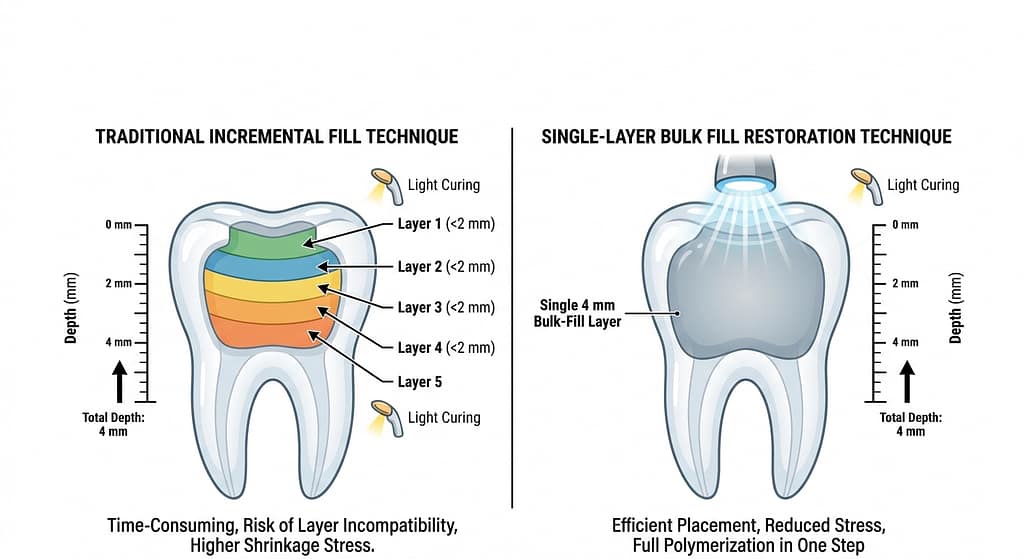
What Are Bulk Fill Composites?
Bulk fill composites are restorative materials designed to be placed in increments of 4–5 mm—significantly thicker than traditional composites, which typically require 2‑mm increments. They achieve this through:
- Higher translucency allowing deeper light penetration.
- Modified resin chemistry (often containing photo‑initiators like Ivocerin or alternative polymerization systems) that enable adequate curing at depth.
- Reduced polymerization shrinkage and lower shrinkage stress compared to conventional composites.
Two main categories exist:
| Type | Description | Examples |
|---|---|---|
| Low‑viscosity (flowable) bulk fill | Used as a base layer under a conventional occlusal layer | SDR (Dentsply), SureFil SDR flow |
| High‑viscosity (sculptable) bulk fill | Used as a single restorative material, often with a capping layer | Tetric EvoCeram Bulk Fill, Filtek One Bulk Fill, SonicFill |
What Does the Clinical Evidence Say?
✅ Survival Rates
Systematic reviews and long‑term clinical trials have shown that bulk fill composites have comparable survival rates to conventional layered composites at 3–5 years. A 2022 meta‑analysis found no significant difference in annual failure rates (around 1–2%) when bulk fill materials were used within their indications.
✅ Marginal Integrity
Marginal adaptation—a key predictor of restoration longevity—is generally excellent with bulk fills, particularly when used with a proper adhesive protocol. Some studies even suggest lower marginal gap formation due to reduced shrinkage stress.
✅ Postoperative Sensitivity
Because bulk fill composites generate less polymerization stress, they are associated with lower postoperative sensitivity in deep Class I and Class II restorations compared to traditional composites placed in thick increments.
⚠️ Considerations
- Wear resistance: Some high‑viscosity bulk fills show slightly lower wear resistance than premium hybrid composites in high‑stress areas. Placing a conventional occlusal layer (a “capping” technique) is often recommended for molars.
- Depth of cure: While marketed for 4–5 mm, actual depth of cure can vary by material, light intensity, and tooth shade. Always verify with manufacturer instructions.
Best Indications for Bulk Fill Composites
Bulk fill materials shine in specific scenarios:
| Indication | Why It Works |
|---|---|
| Deep Class I cavities | Reduces layering time, minimizes risk of voids |
| Class II cavities with proximal boxes | Flowable bulk fill can be injected into the box, ensuring adaptation |
| Large foundation restorations / build‑ups | Fast, strong core build‑up in one increment |
| Pediatric restorations | Short attention span; faster placement |
| Posterior teeth with high C‑factor | Lower shrinkage stress reduces risk of marginal failure |
Limitations & When to Avoid
Bulk fill composites are not a universal replacement for all composites. Avoid or use with caution in:
- High‑wear areas without a capping layer: In patients with bruxism or heavy occlusal forces, a wear‑resistant conventional composite should be placed as the occlusal layer.
- Esthetic zones: Bulk fill materials generally have lower translucency options and may not match the chameleon effect of premium anterior composites.
- Inadequate curing conditions: If your light‑curing unit is not powerful (≥1000 mW/cm²) or if the restoration is deep and light access is poor, curing may be compromised.